
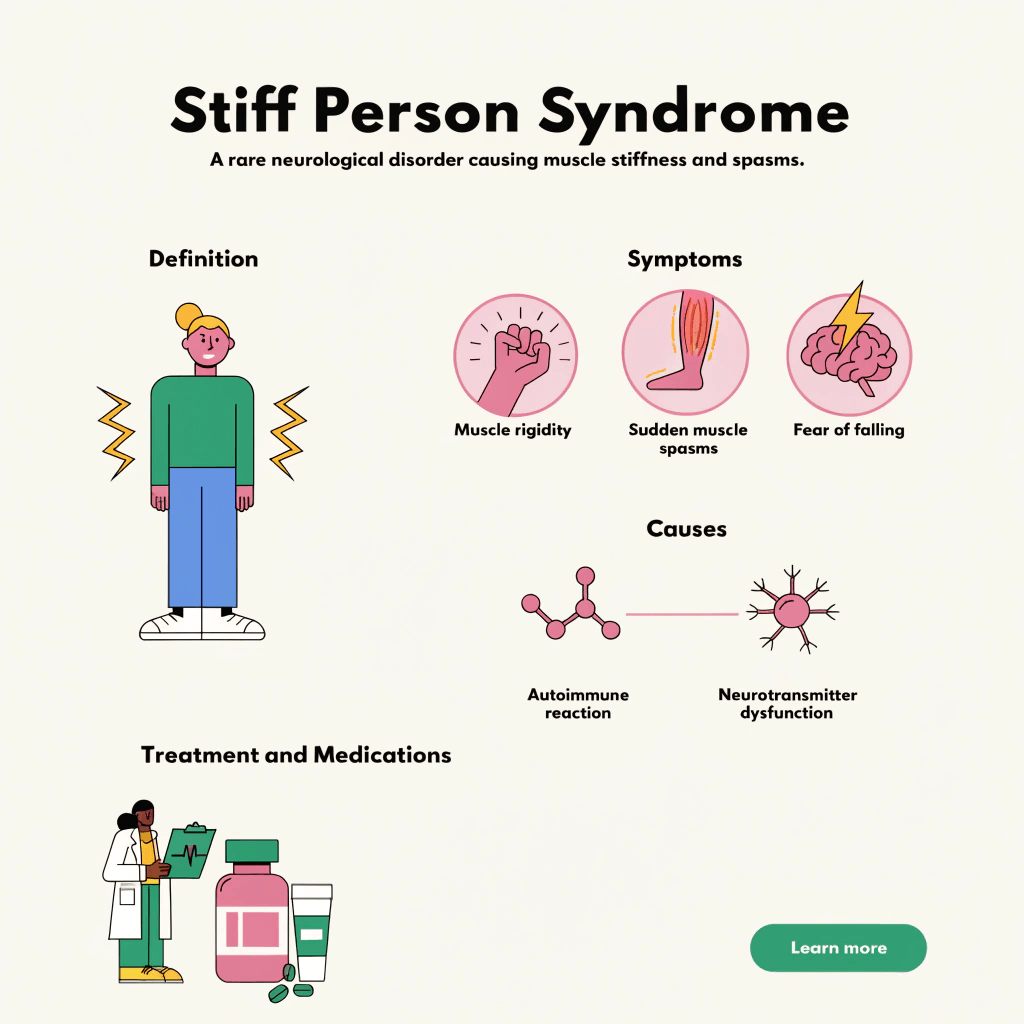
Stiff-person syndrome refers to a rare condition where the brain sends confused signals, so muscles stay stiff instead of relaxing.
Your muscles are supposed to tighten and then let go in general. With this condition, the “let go” part doesn’t work properly, so the muscles just stay locked. If you or someone you identify has these symptoms, then you’ll probably assume stiff muscles and unexpected painful spasms. Walking can feel unfixed too, and there’s often an unbearable worry about when the next spasm might strike.
According to medical terms, the immune system mistakenly attacks healthy nerve cells. This is mainly bound to low levels of an enzyme called “GAD,” which normally helps muscles stay calm. There’s no cure yet, and that’s tough to hear. But doctors do have directions for relief, including muscle relaxants, physiotherapy, and treatments that calm down the immune system.
One medicine we hear about regularly is diazepam. It works by calming the nerve signals, so the muscles don’t stay locked up as much, and that brings real relief from stiffness and spasms. Now, here’s something you must know if you’re in the UK. You can’t just buy diazepam from a shop. A doctor has to prescribe it, because it’s a controlled medicine, and it needs proper medical supervision to be used safely.
What is stiff person syndrome, or SPS?
Stiff-person syndrome, also known as stiff-person syndrome, stiff-man syndrome, or SPS, is a rare neurological disorder. It’s an autoimmune disease. It affects the central nervous system. It causes stiffness and spasms that get worse over time. According to the National Institute of Neurological Disorders and Stroke, SPS affects about one to two people per million. That’s incredibly rare.
According to Dr Andrew McKeon of Mayo Clinic, more than half of patients also have another autoimmune disease. This backs up the idea that SPS is linked to the immune system. Here’s how it works, in simple words. The immune system gets confused. It attacks parts of the brain and spinal cord by mistake. This messes up how the body controls movement. That’s what causes stiffness, spasms, and a jumpy startle response.
According to historical records, doctors first wrote about this back in 1956. Frederick Moersch and Henry Woltman described it. They saw it in 14 patients. That’s where the history of SPS really begins.
What is The History of Stiff Person Syndrome?
The history of stiff-person syndrome started in 1956, and honestly, I’m uncovering it hypnotic how long doctors struggled just to give this condition a name. Think about it. Before 1956, doctors observed patients with strange, board-like stiffness in their muscles, and they had no clear response to what was happening. Think how horrific that must have been, both for the patients and for the doctors trying to heal them.
Then came a real turning point. In 1956, two doctors, Frederick Moersch and Henry Woltman, studied 14 patients at the Mayo Clinic over several years. They finally gave the condition a name and a proper description. From there, things took forward steps step by step. In 1988, researchers disclosed that most patients had unusual antibodies hitting GAD, a substance that normally helps muscles stay relaxed. This was a huge clue, and it changed how doctors thought about the condition completely.
By 1991, the name transformed again, this time to “stiff-person syndrome”, since doctors realised women were affected far more often than men. You can see how the name itself tells a story of growing understanding. Today, Doctors now recognise several types of stiff-person syndrome, involving the classic form, focal type, PERM, and the paraneoplastic form linked to cancer. Each type behaves a little differently, and knowing which one someone has really shapes their treatment plan.
What are The Symptoms of Stiff Person Syndrome?
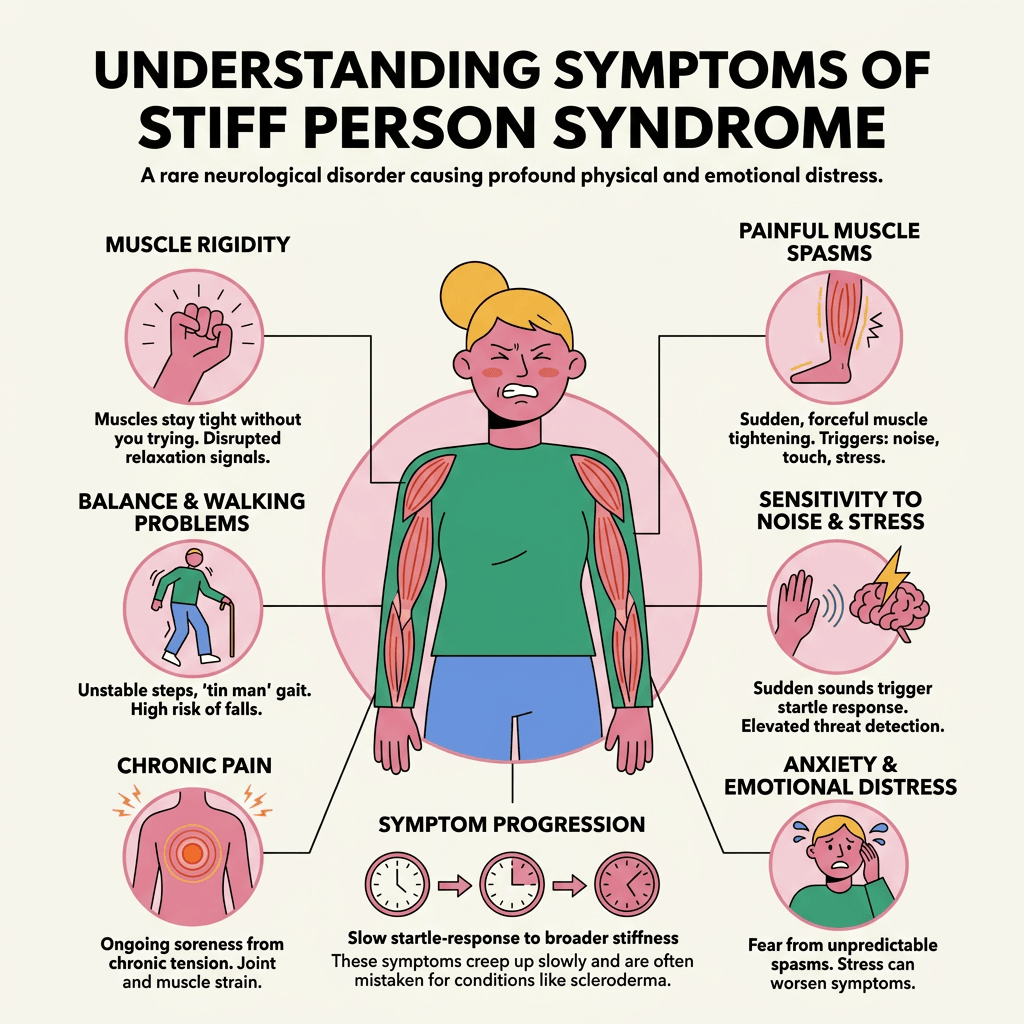
The symptoms of stiff-person syndrome cover muscle stiffness, spasms, balance problems, noise sensitivity, chronic pain, and emotional distress. They’re often misdiagnosed as scleroderma or other conditions. The symptoms of stiff-person syndrome are listed below.
- Muscle rigidity: muscles stay tight without you trying. Nerve signals that should rest muscles get disrupted here.
- Painful muscle spasms: sudden, forceful muscle reduction happens fast. Common spasm triggers include noise, touch, and stress.
- Balance and walking problems: stiff muscles make steps feel unstable. These gait abnormalities increase your risk of falls.
- Sensitivity to noise and stress: sudden sounds trigger a jump response. The nervous system reads it as a threat.
- Chronic pain: ongoing soreness builds from current muscle tension. Constant spasms strain the muscles and joints too.
What is the Difference Between Stiff Person Syndrome and Scleroderma?
The difference between stiff-person syndrome and scleroderma is where the problem starts. SPS is a rare disorder of the nervous system. Scleroderma, on the other hand, is a connective tissue disease. It mainly thickens the skin, and it can affect organs too.
SPS comes from disrupted nerve signals that cause spasms. Scleroderma comes from fibrosis, where the tissue itself changes and hardens. It’s worth knowing that SPS is sometimes misunderstood as ALS too. Both can cause stiffness and weakness, but ALS affects motor neurons, and it follows a different pattern altogether.
What is the Difference Between Stiff Person Syndrome and ALS?
The difference between stiff-person syndrome and ALS is the cause behind the stiffness. SPS comes from disrupted nerve signals in the spinal cord and brain. ALS, on the other hand, is a motor neuron disease. It slowly damages the nerve cells that control muscles, and this leads to weakness that gets worse over time.
The key science-based difference is this: SPS causes stiffness and spasms, but muscles usually stay strong. ALS causes muscles to weaken and waste away, alongside stiffness in some cases. This is why understanding the early signs really matters. Getting the right diagnosis early helps doctors choose the right treatment path, and it can make a real difference to how someone manages the condition going forward.
What are the Early Warning Signs of SPS?
The early signs of stiff-person syndrome are listed below.
- Mild stiffness: this often shows up first in the trunk or lower back. It tends to get worse when you move.
- Unexpected spasms: these are sudden muscle contractions. Noise, touch, or stress can set them off without warning.
- Posture changes: your body alignment can shift slightly. This happens because muscles stay overactive and tight for too long.
- Fear of walking or falling: Early balance problems and past spasms make people move more carefully.
- The causes of stiff-person syndrome: this usually comes down to autoimmune trouble. The immune system disrupts nerve signals that should calm the muscles.
What are the Causes of Stiff Person Syndrome?
The causes of stiff-person syndrome include autoimmune trouble, unusual antibodies, and disrupted nerve signals. The immune system mistakenly attacks proteins that control movement. This leads to stiffness and spasms. The causes of stiff-person syndrome are listed below.
- Autoimmune Response: Autoimmune response refers to the immune system attacking healthy nerve tissue by mistake. Autoantibodies target pathways that normally calm muscle activity down.
- Gad Antibodies: GAD antibodies means the immune system attacks glutamic acid decarboxylase (GAD). This lowers GABA levels, so nerves fire too easily and cause stiffness.
- Nervous System Dysfunction: Nervous system dysfunction refers to faulty brain and spinal cord signals. These circuits normally stop muscles from firing too much on their own.
- Related Autoimmune Diseases: Related autoimmune diseases means SPS often appears alongside other conditions. This overlap points to shared risk-factors within the immune system itself.
- Diabetes: Diabetes, especially type 1 diabetes, refers to a condition where autoantibodies also attack the pancreas.
What are the Risk Factors and Triggers of SPS?
The risk factors and common triggers of SPS are listed below.
- Stress: This raises the body’s alert response. It can make muscles tighter and bring on spasms.
- Sudden movement: Quick, abrupt motion can set things off. It often triggers involuntary muscle contractions straight away.
- Loud sounds: unexpected noise can startle the nervous system. This can spark a spasm without warning.
- Cold temperatures: cold weather can worsen stiffness. It tends to increase muscle tension overall.
- Emotional distress: fear, worry, or tension add fuel here. They amplify nervous system overactivity and trigger flare-ups.
- Impact on everyday living: Reduced mobility and constant caution make daily tasks harder and more tiring.
How Does Stiff Person Syndrome Affect Daily Life?
The ways stiff-person syndrome affects adults are listed below.
- Mobility limits: standing, walking, and bending become harder. Stiff muscles and spasms disrupt routine activities daily.
- Falls and injury risk: sudden stiffness throws off balance. This raises the chance of falls and injury.
- Fatigue and pain: constant muscle tension wears the body down. Repeated spasms bring soreness and low stamina.
- Work and household tasks: lifting, cooking, and cleaning get tougher. Standing for long periods becomes hard too.
- Emotional strain: unpredictable symptoms can bring anxiety.
- In men: symptoms can affect strength-based tasks. Movement confidence and daily independence often take a hit.
- In women: symptoms can complicate caregiving duties too. Household tasks and mobility-dependent routines become harder to manage.
- Relationship impact: ongoing pain and mobility limits matter here. Social life, intimacy, and support from others can all shift.
How is Stiff Person Syndrome Diagnosed?
The main ways to diagnose stiff-person syndrome are listed below.
- Neurological examination: a doctor matches stiffness, reactions, and gait. This helps spot movement problems linked to SPS.
- Blood testing: this looks for antibodies like anti-GAD. It helps support an autoimmune cause behind the condition.
- Electromyography (EMG): This test measures electrical activity in muscles. It can show the constant firing typical of SPS.
- Differential diagnosis: doctors rule out other conditions here. Parkinson’s disease, multiple sclerosis, and scleroderma often get checked first.
- DSM-5 criteria: DSM-5 covers psychiatric conditions, so it isn’t used to confirm SPS, though anxiety can exist alongside it.
- Curing: There’s no definitive cure right now. Doctors attentions to treating symptoms instead of curing the condition itself.
Are There Any Cures for Stiff Person Syndrome?
No, there is no permanent cure for stiff-person syndrome because it’s a chronic autoimmune condition affecting the central nervous system. It needs ongoing management rather than a one-time cure. The good news is, it’s treatable and manageable. Medications, immunotherapy, and rehabilitation can all reduce stiffness, spasms, and daily disability. In my view, this matters most. With the right care plan, many people improve their function and quality of life, even without a full cure.
What are the Treatments of Stiff Person Syndrome?
The treatment choices for stiff-person syndrome demand medical, immune-based, and rehabilitation approaches. They choose the right plan based on your underlying causes and symptoms. The treatments for stiff-person syndrome are listed below.
Muscle Relaxants: Muscle relaxants relax nerve-muscle signals to ease stiffness. Baclofen is commonly used here as an evidence-based option.
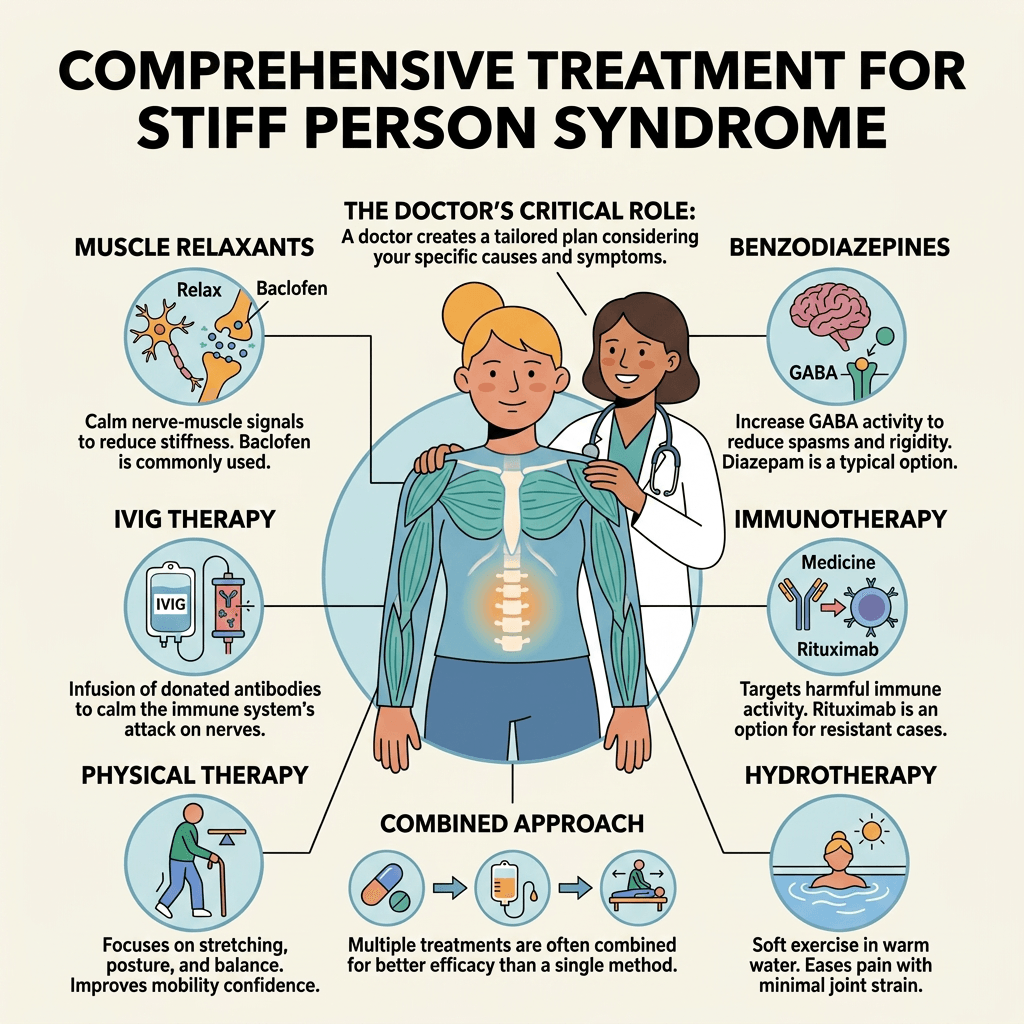
Benzodiazepines: Benzodiazepines raise GABA activity in the brain. Diazepam is common, and it assist reduce spasms and stiffness well.
IVIG Therapy: IVIG therapy uses donated antibodies through an infusion. Intravenous immunoglobulin can calm the immune system’s attack on nerves.
Immunotherapy: Immunotherapy targets harmful immune activity directly. Rituximab may assist when standard treatment doesn’t act well enough.
Physical Therapy: Physical therapy involves stretching, posture work, and balance training. It improves confidence and helps you move more safely.
Hydrotherapy: Hydrotherapy means exercising softly in warm water.
In my view, a doctor should constantly guide this plan. Combining these treatments often assist better than relying on just one.
Is Seeing a Doctor Necessary Before Taking Stiff Person Syndrome Medications?
Yes, seeing a doctor is necessary before taking stiff-person syndrome medications because these treatments affect the nervous system directly. These medicines can interact with others, and dosing needs to match your exact symptoms.
Medical supervision reduces risks and confirms the right diagnosis first. This makes sure treatment stays both safe and effective for you.
A doctor checks your stiffness, spasms, and mobility problems closely. They also look at other health conditions and any current medications you take.
The doctor keeps monitoring things afterwards too. This includes side effects, treatment response, and blood tests when needed, so the plan stays safe over time.
What are the Best Medications for Stiff Person Syndrome?
The best medications for stiff-person syndrome include medicines that calm nerve overactivity and ease spasms. These should always be used under a doctor’s supervision.
The medications for stiff-person syndrome are listed below.
Diazepam: A benzodiazepine that enhances GABA-mediated calming in the brain. It often brings fast relief from stiffness and spasms.
Baclofen: Baclofen is a muscle relaxant that lowers nerve signalling in the spinal cord. This eases tightness and helps with daily movement.
Other benzodiazepines: Other benzodiazepines work by strengthening inhibitory signals too. In my view, these can genuinely improve comfort and everyday function for many people.
How Does Diazepam Help Relieve the Symptoms of Stiff Person Syndrome?
Diazepam helps relieve the symptoms of stiff-person syndrome by boosting GABA’s calming effect in the brain. It enhances GABA at the GABA-A receptor, which fights back against the reduced GABA signalling behind the stiffness.
It works as a muscle relaxant, sedative, and anticonvulsant all at once. This helps reduce rigidity, ease painful spasms, and calm the anxiety that often comes with it.
In my view, this combined effect is why diazepam brands like Bensedin help so many people move and feel more comfortable day to day.
What are the Legal Ways to Buy Diazepam for SPS in the UK?
The legal ways to buy diazepam for stiff-person syndrome in the UK are listed below.
- GP prescription: your GP assesses your symptoms first. They then prescribe if it suits you.
- NHS repeat prescription service: once prescribed, you can order repeats. This works through your GP surgery or the NHS app.
- Registered UK pharmacies: you collect diazepam from any pharmacy. A valid prescription is always required beforehand, though.
- Private prescription services: some online UK services offer this route. A registered doctor still needs to prescribe it first.
In my view, this really comes down to one thing. A prescription is always the starting point, no matter which route you choose.
Is It Possible to Buy Diazepam for Stiff Person Syndrome in the UK Without a Prescription?
No, it is not possible to buy diazepam for stiff-person syndrome without a prescription in the UK because it’s a controlled medicine by law.
Diazepam is a Class C, Schedule 4 controlled drug in the UK. This means a doctor must assess you before you can buy diazepam legally. It protects patients across all types of stiff-person syndrome, since dosing depends on your specific symptoms of stiff-person syndrome and the causes.
There’s no legal shortcut here, even in urgent situations. No shop can hand over diazepam without a prescription. Always rely on trusted brands like Bensedin Galenika instead of buying from any random websites, as the NHS & MHRA frequently warns.